June 18th, the second day in the mountains
I wake up at 6:00 in the morning. The girls and Julien are still sleeping. It’s cold. I pull up the blankets and make sure the girls are warm. Around 6:30 L. and I. wake up too and we go to the living room where Yachan is drinking some lemon water.
Michael is out to get water from the well. There is one not far from the house. They don’t use a pomp. Instead, they walk down in the morning to fill jerry cans of water and carry it back up the hill. Michael made a special wooden tool to carry as much water as possible without hurting his back. He also made a smaller one for Yachan, fitting her neck perfectly. I ask why he doesn’t make a car with wheels but he says he likes the effort. It’s heavy, but at the same time it’s a good workout. They want to stay as strong as possible.
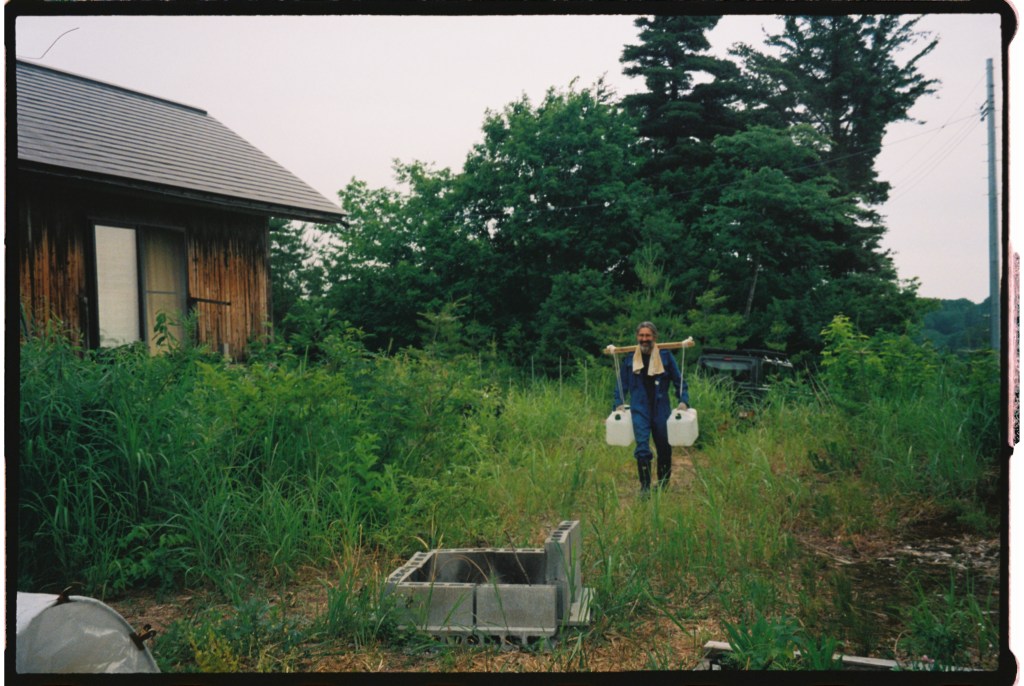
Michael comes back sweating with two big jerry cans full of water. Yachan makes us coffee and gives the girls some of Michaels homemade granola. I. eats everything, but L. nothing. Yachan offers her plain soy yoghourt with maple syrup which she accepts, but after one bite she leaves the table and says she is full. I eat her granola, of which I’m sure she won’t touch it anymore. It’s delicious! Oats with dried banana, goji berries, mulberries, walnuts, peanuts and a touch of anis. I’m surprised to find all these kind of power foods on top of this mountain.

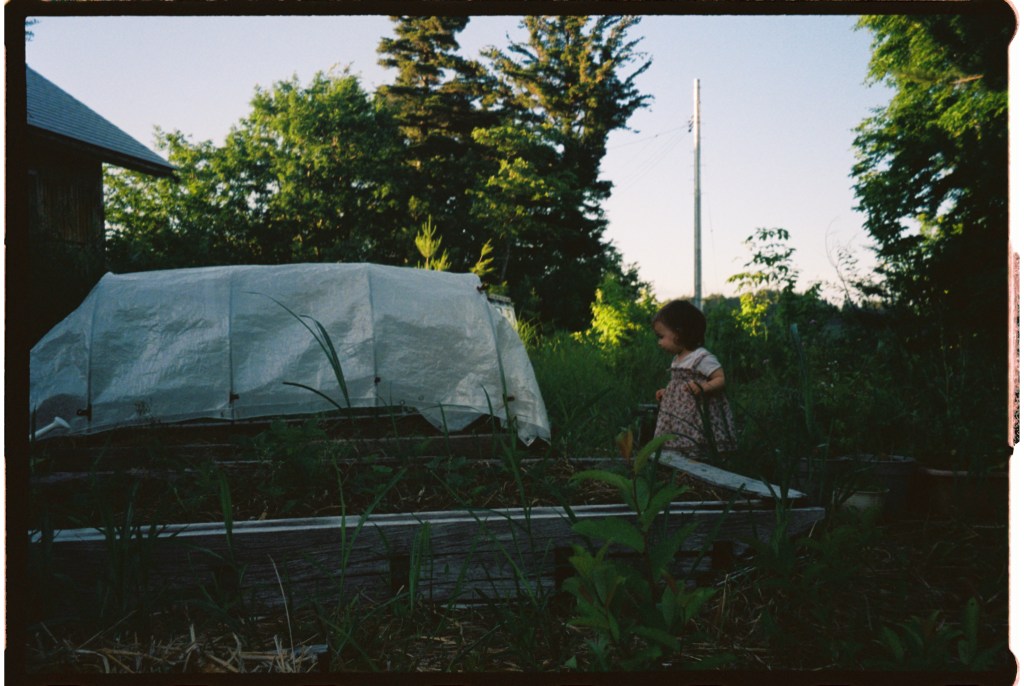
We spent the whole morning in and around the house. Of course there is always work to do. Water the plants, herbs and veggies. Daily routines. It will be very warm today, so the earlier you do these errands, the better.
Michael doesn’t speak Japanese. He and Yachan speak English together. They met in Melbourne and moved to Japan a few years later. It’s the first time I hear L. speak English. She is doing her utmost best to connect to him. I’m surprised by how much she seemingly enjoys practising her English. And also by how smoothly she swifts from language to language. She speaks English with Michael, then switches to Japanese to communicate with Yachan, then to Dutch to ask me something, back to Japanese with Julien, English with Michael and when I. passes by she shouts something to her in Dutch, although it can also be something Japanese.
“I wish there wasn’t compulsory education from five years old. When I look at L. and see what she has been learning in the last weeks I believe no school could ever beat it.”
I wish there wasn’t compulsory education from five years old. When I look at L. and see what she has been learning in the last weeks I believe no school could ever beat it. She has been making such big jumps in her Japanese, she has been practising her English (she goes to a bilingual school), she is helping to cook, she cuts wood, she poops outside in nature while learning the zodiac, she has learned news songs, she has been drawing every day, she solves puzzles we can’t solve. I wish we could continue doing this a few more years and stay out even longer.
Tentanmen for lunch!
We eat Yachans lunch. Tentanmen, soy milk noodles – somen, a super thin ‘summer noodle’ – with veggie meat. It’s delicious. L. hardly eats. A few bites of plain noodles. She is covered in mosquito bites, still from Tokyo. Big red, painful swellings. She looks tired. I hope she’ll take a nap after lunch but I. is the only one who goes to bed. L. is too excited to sleep and she continues to explore the house and these new people. I ask Julien to try to get her to nap, but he fails. He ends up sleeping and L. comes back to the room.
Letting go of your belongings
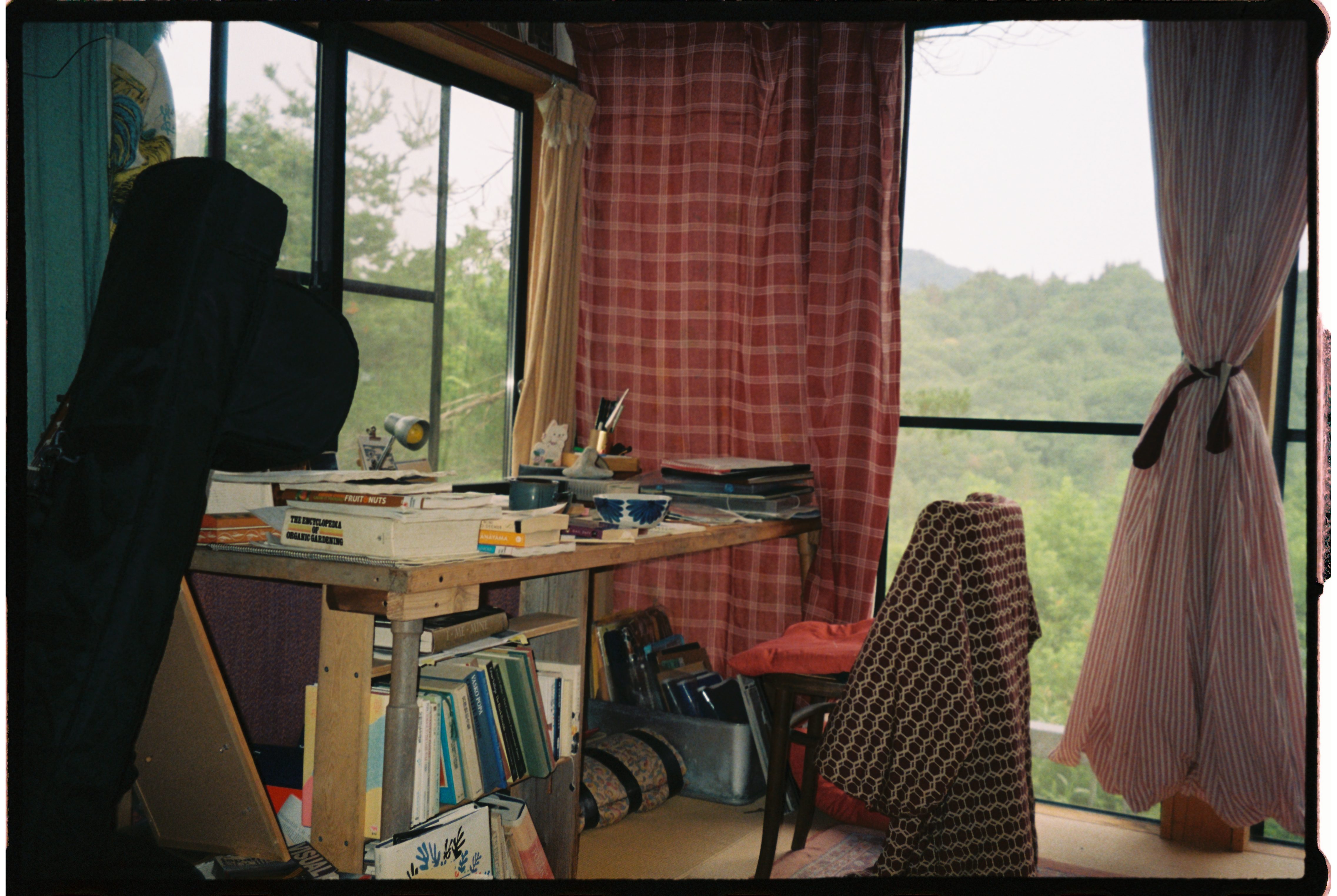
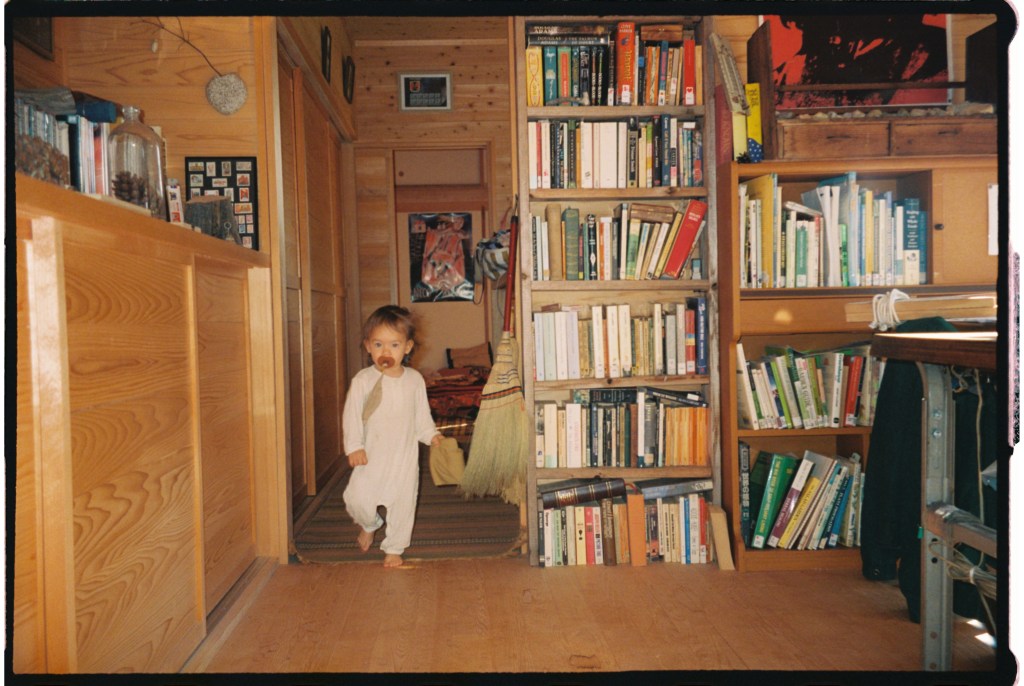
The rest of the afternoon we sit together in the house and talk. It has become super hot, but with all the doors open a nice breeze goes through the house. It’s such a beautiful house, on top of the tallest mountain around. From every window you overlook valleys and the endless mountains of Yamagata. Yachan and Michael lead such peaceful lives here. Surrounded by their books, music and fabrics. Inside the spacious living room are two desks, with pens, paper, and lots of small treasures. Books, notebooks, poetry, images. Personal belongings. It looks like every object in their house has a purpose.
The more surprised I am to learn Michael wants to get rid of all of his belongings. Eventually they want to live as nomads, he explains. With nothing.

When I look around this house, I see a lot of beautiful objects, but nothing seems of unnecessary luxury. Books, films, lot’s of music. Aren’t those kind of objects just food for the soul? I don’t understand! To Michael they’ve started to become a burden. His belongings have always been his anchor. They have been brought him comfort and security. They have served as his identity. But lately, he feels they keep him from making choices. More importantly, he doesn’t want objects to give him comfort and security. He wants to be comfortable and secure by life itself. By the earth, the bugs and trees.
“He wants to be comfortable and secure by life itself. By the earth, the bugs and trees. “
Julien, who always believes I have too many belongings, can only agree. We come from totally different backgrounds when it comes to belongings. Juliens father didn’t want to possess anything. He always wanted to stay as light as possible so that he could travel anywhere at any time. My father is a great collector and my mum was a big reader. My family home is full of literature, design furniture and a collection of robots, ADCO vases in all colours of the rainbow, vintage Ricard water jugs, bakelite radios and other bakelite objects and many more collectables.
For me these types of belongings embody my family’s love for life. I think it would be different if my parents would have collected expensive electronics, watches or cars, but they never cared about the status of objects at all. My fathers passion is collecting itself. He needs to work for his collection. Growing up in a protestant family he himself became a strong atheist, but he couldn’t escape the dutch calvinist work ethics.
‘It sounds beautiful’, I tell Michael, ‘but I’m not ready. I can’t imagine letting go of my books and records just yet! Are you sure about this?’
It really makes me think, especially because I’ve always felt quite similar to Michael. Will I feel the same in 15 year? Maybe I will never come to this point because I have children? Or because I don’t live in Japan (yet)? Will I dislike my beautiful and soulful objects in the future?
‘It will take time’, he says. ‘But I think I’ll be starting to get ready to get rid of some of my books.’
‘Feel free to give me one’, I say. ‘I’d be honoured.’
Leave a Reply