
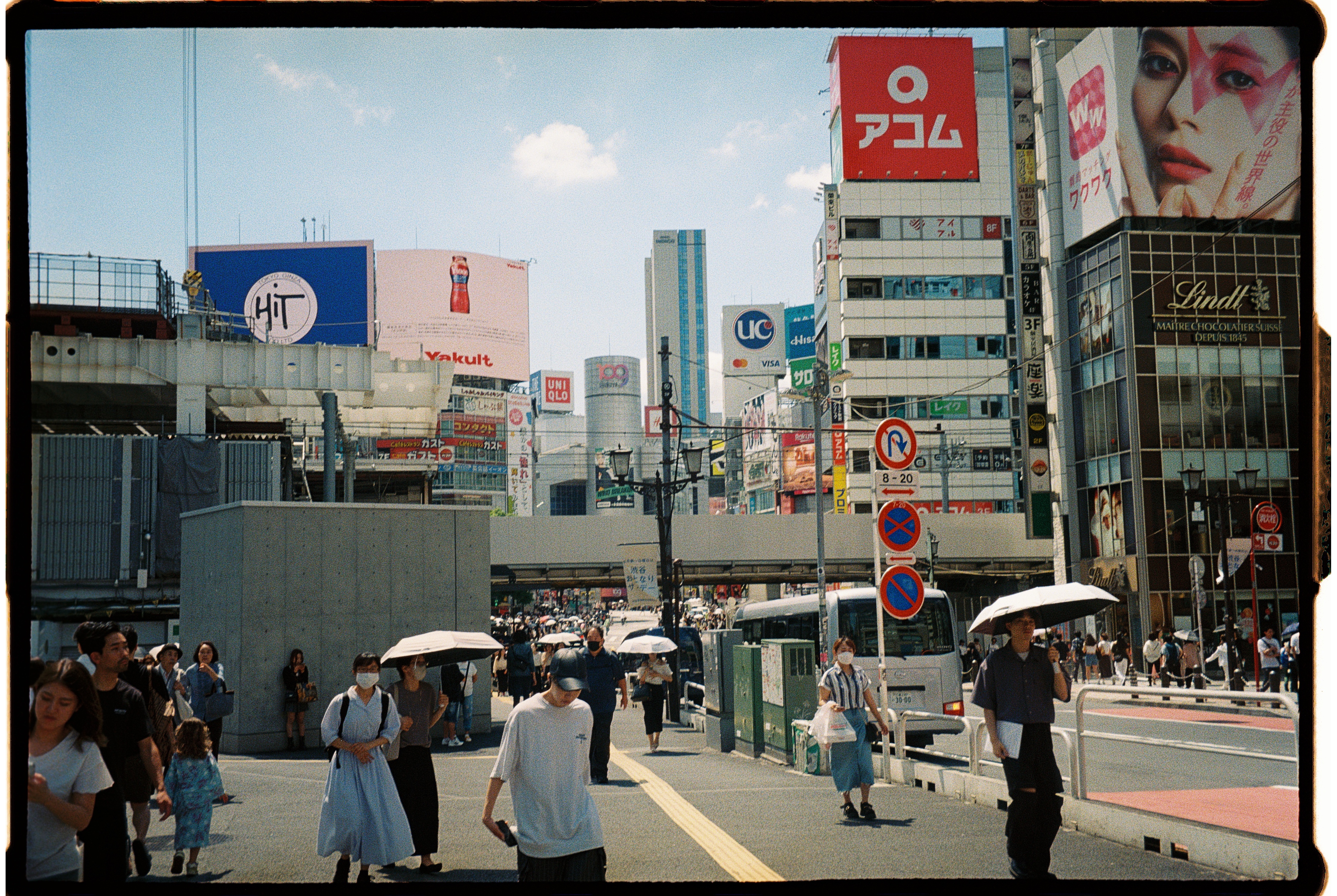
June 12th, the third day in Tokyo
I wonder if all days in Japan will be 10-minute reads. I suppose at some point, when we end up at the beach, there isn’t much to tell and two days might become one. At the same time, the less we do the bigger our thoughts get, don’t they? Creativity flows when kids are bored, same for their parents.
The kids wake up at 8:00 in the morning. For 30 minutes I try to get them back to sleep, because it was late last night and 8:00 is too early! Are we getting adjusted to the actual time zone? I guess humans like to wake up with the light. Especially children. But it has been light, since 4:00 in the morning. Maybe they are too tired now, or too excited, with too much adrenaline. L. often wakes up early, when she is excited. Meeting the family last night definitely could be a reason for her.
Julien has to leave for work around 11:00 today, and he will be out until late in the afternoon. I want to take it easy and let the kids – at least I. – nap at home today, not in the stroller. It’s going to be hot, 30 degrees, and I want to take them to an indoor playground this morning.
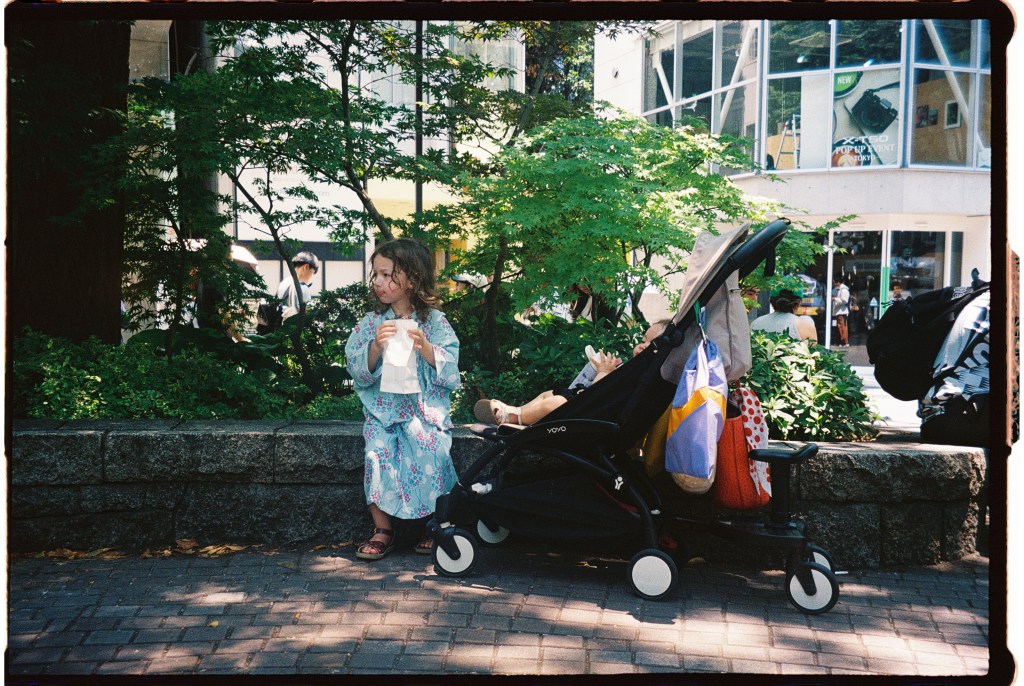
Mochi Donuts
I let Julien sleep, and prepare breakfast for the kids. Fresh rice with natto and soy yogurt. I. eats, L. only a few bites. I get ready, while they sit at the high table and eat. We leave for Shibuya. We take a shortcut walking slowly through the swirling streets behind Takeshita Dori and we end up close to Harajuku station. On our way, we pass by a famous donut shop – I Am Donut – with a normally never ending line. It’s just before 10, and L. looks at the shop with big yearning eyes. The line is very small this early. The shop hasn’t even open yet, but will in a few minutes.
“L.”, I ask, “shall we try one of those delicious donuts?”
She looks confused. What is she proposing? Is this real?
“Let’s get one to share?”
She runs to the line.
I could never wait in line for a donut. Not even for a high quality, Japanese, mochi donut. With only 4 people waiting in front of us, it takes just a few minutes.
L. loves our donut and I’m glad to see her enjoy some food. I have to try one bite, but let her finish the rest. I. has eaten a lot of rice and isn’t very interested. Also for the best. I would rather not have her eat sugary food, before she turns two years old. It’s really difficult to keep these kind of principles, with the second one. She can say like 5 words and one of them is ijsje, the Dutch word for ice cream.
Coffee in Shibuya
We move on towards Shibuya by foot. It’s only 15 more minutes and it is still morning, but the sun is burning. It feels like it takes forever. The kids are impatient. Me too, because I want to drink a coffee before spending hours in what seems like kind of a nightmare: an indoor playground. I just need to find a coffee shop, with a space where the children can move around a bit.
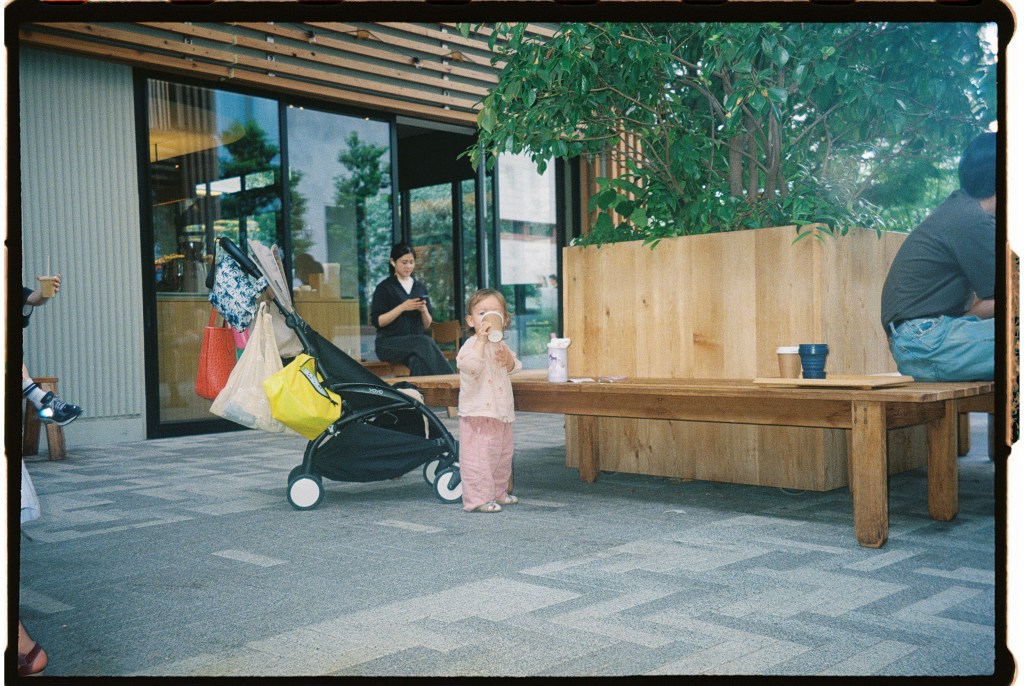
I have a vague memory of a quiet, spacious Blue Bottle Cafe, in in the midst of Shibuya, behind the buzzing main streets. I haven’t been there a few years, but I remember an oasis of calm with a coffee. I’m not disappointed when we arrive. A beautiful wooden building in the middle of a park like square. I don’t understand why, but this chain has such a range of beautiful spaces in Tokyo and beyond.
I have my coffee, the kids explore. I. popcorns around and L. talks with the barista’s who are super kind to her. It surprises me how incredibly kind people can be to my child, who likes to talk to them all the time and ask questions such as: “What are you doing? Why? What are you doing now? Can I help? What’s your name?”
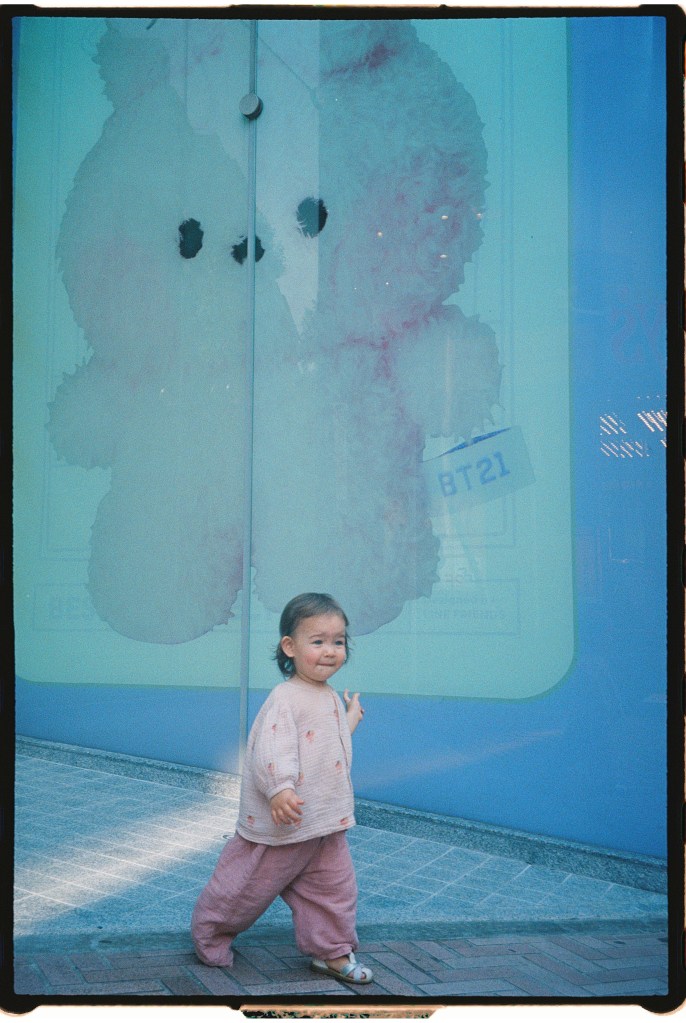
An Indoor Playground
After we all finished our drinks, we move to the indoor playground, a place called ‘Co- Shibuya’.
Co- Shibuya is a community centre for kids, created by the city of Shibuya. It’s situated in another backstreet, with nothing but some offices. It seems confusing when I turn into the street, but once we arrive at the right building its quite clear. It looks beautiful. Lots of wood and glass. Through the window I see a tall, wide wooden staircase leading up into the building. Along the staircase there is a big wooden structure, with round windows. We see children playing, crawling through the windows. I push the stroller inside, out of the burning sun and into the air conditioning. I look around and try to understand what to do next. There is a sign, that shows a pair of shoes with a red cross and a pair of bare feet with a red cross and a pair of feet with socks with no red cross.
Socks.
I don’t have socks on me; I’m wearing my sandals.
“Sorry kids”, I sigh, “we need to get mama socks first.”
(And of course there is the f-word in my head and few more curses, because its already almost 11:00 and its so hot and I don’t want to go to the main streets of Shibuya with hundreds of people, pushing this very heavy stroller with 2 kids on it, but I will have to.)
I end up in Muji, only 5 minutes away. I have to search the whole building to eventually find the socks on the top floor. I run back – uphill – to the community centre and push the stroller inside and try to forget everything that just happed, the only reminder the sweat dripping off my face.
We park the stroller – there is a stroller parking – and enter the elevator. Floor 2 or 3? We pick floor 3.
We enter a spacious, big room with tall windows. There are lots of wooden toys. It’s very calm. There are only two more kids playing. Really young kids. One must be about 4 months and one that seems I.’s age, but isn’t walking yet. Far from that.
A lady in uniform walks towards me and asks slowly and carefully in Japanese if I live in Shibuya.
“In Harajuku.”, I reply, thinking she is just curious how I found this place.
“Okay”, she replies. “Please come in.”
She tells me the kids can go play, while I need to fill out some form to register them. I. is beyond excited and runs – screaming from happiness – to a small wooden slide that she recognises from her creche, back in the Netherlands. L. goes to a kitchen where they have noodles (shoe laces; nice idea), sandwiches (felt pieces of fabric), wooden veggies and fruits (round shapes in various colours) and many more open-ended kitchen toys.
While filling out the form – a paper one, because the QR code she asked me to scan didn’t work on my phone, because I don’t have a Japanese phone and I don’t live in Shibuya: I’m just a tourist – I realise this space is only for people who actually live in Shibuya ward. However, it’s too late to turn back now. The kids seem obsessed with the space, L. is in the middle of cooking a festive meal and I. is sliding down the slide for the 10th time.
I decide not to say anything and pretend the house in Harajuku is my house. The lady is a bit confused to see my Dutch phone number, but she doesn’t seem to want to make a scene either. My kids are registered and can play as much as they want.
It’s really not a nightmare at all, this indoor playground. I take out my notebook and sit down on a bench with a view on both kids. They play without stopping or bothering me. The only moment I need to look up is when I. screams because the other 1 year old crawles a bit too close to ‘her’ slide. She is becoming just as bossy as her sister.

Dumb Phones
One of the major themes of my own trip this year, is that I want to stop using my smartphone. I hate my smartphone. I hate everyone’s smartphones. I started using one relatively late- around 2013 – , but I really don’t like it. After ten years of carrying around a smartphone, I have came to realise that all my fears of losing my creativity and energy, are not related to too many drink and dr*gs around the end of my 20s and also not to becoming a mother in my 30s. They are tied to one thing: my smartphone that now completely dictates my life.
This phone counts my steps; answers every questions I have, tracks my screen time and even knows when I have my period. It gives me advertisement related to conversations that I had with friends in the middle of the night. It provides such strict directions that I forget to look around. I hate that phone. I hate Julien’s phone. I hate what this phone does to my kids. I don’t want it anymore.
I used to live in Tokyo without a smart phone. Did I get lost? Maybe. Did I survive? Hell yeah. Was I creative, active, always surprised? Yes, I was. That wasn’t because I was young or anything. I was just looking up and down and ahead. If we didn’t remember the name of an actor, someone would shout it out an hour later, it in the middle of a different conversation and it would be hilarious. Who needs a smartphone?
When I was taking the morning train in Tokyo in 2009 – right as smartphones were making their entrance – everyone was either sleeping or reading novels, newspapers, manga and hentai – pornographic manga. I used to love trying to translate what others were reading, their katakana book titles, and occasionally catching a glimp of the pornographic images of hentai, over a salaryman’s shoulder. Nowadays everyone is glued to their phones. Like zombies.
I don’t want to sound like a hippy who says back in the days everything was better, but I do believe our smartphone – or the way we have been using it – is toxic. The Tokyo subway I the perfect illustration of how much smart phones have changed our lives in just 15 years.
As I revise this text 2.5 months later, I still have a smartphone. I use it less, because I don’t call with it anymore. I use an iPhone 6 to call. It doesn’t have any apps. I take that phone out and leave the iPhone 14 inside the house when possible. I have also got my eyes on a dumb phone, with a navigation system and music. Because the perfect phone doesn’t exist yet. I’ll keep you posted!
A Homemade Lunch
Anyway, I’m in Tokyo, in an indoor playground with the kids, and after writing down a few notes, I join their play. We stay until 13:00 and leave the space, going down to the 2nd floor. This floor is public. It’s for everyone who is interested; also for you.
Kids can play with similar kitchen supplies as the floor above. There is also a really cute, big wooden structure where children above 3 years old can climb and play. Besides, there is a canteen where you can have a Japanese home cooked lunch. For a small amount, your child can have some rice and miso soup, and you can have the same for a little bit more.
There are few different dishes, but I order the most humble one: a bowl of rice, miso soup and some homemade pickles. I order L. a kids’ set, rice and miso soup. The food simple, but really good. L. eats her rice with lots of homemade furikake. She drinks some soup but leaves the veggies behind.
I. eats all of my rice and half of my soup, an adult portion. I really have to start ordering separate dishes for her, otherwise I won’t get to eat.
“Sometimes I feel like a complete idiot, when I’m alone with the children. I walk everything, I carry heavy bags, I never take a train or a taxi. Why don’t I just take a taxi?”
It is scorching hot when we step outside. I almost run back, because I. – with her belly full – is on the verge of passing out, the moment she hits the stroller. Her eyes roll back, as if she is drunk. I want her to sleep in a bed, which would be good for her and me. I want to have a break too. So I start singing loudly with L., trying to keep I. awake. I’m running in the burning sun, sweating, singing loudly, wondering if I should’ve taken a taxi. Sometimes I feel like a complete idiot, when I’m alone with the children. I walk everything, I carry heavy bags, I never take a train or a taxi. Why don’t I just take a taxi? Because I love walking. If the train takes ten minutes and the walk takes twenty, I’ll always choose to walk. But in this heat I wonder: why am I doing this? Isn’t it too hot for them? Or for me?
As usual though, it comes to an end. We reach the house and in the cool comfort of the air conditioning, I. sleeps for a solid 2.5 hours. L. plays, while listens to her Yoto Player. I do some work behind my laptop. We are good.
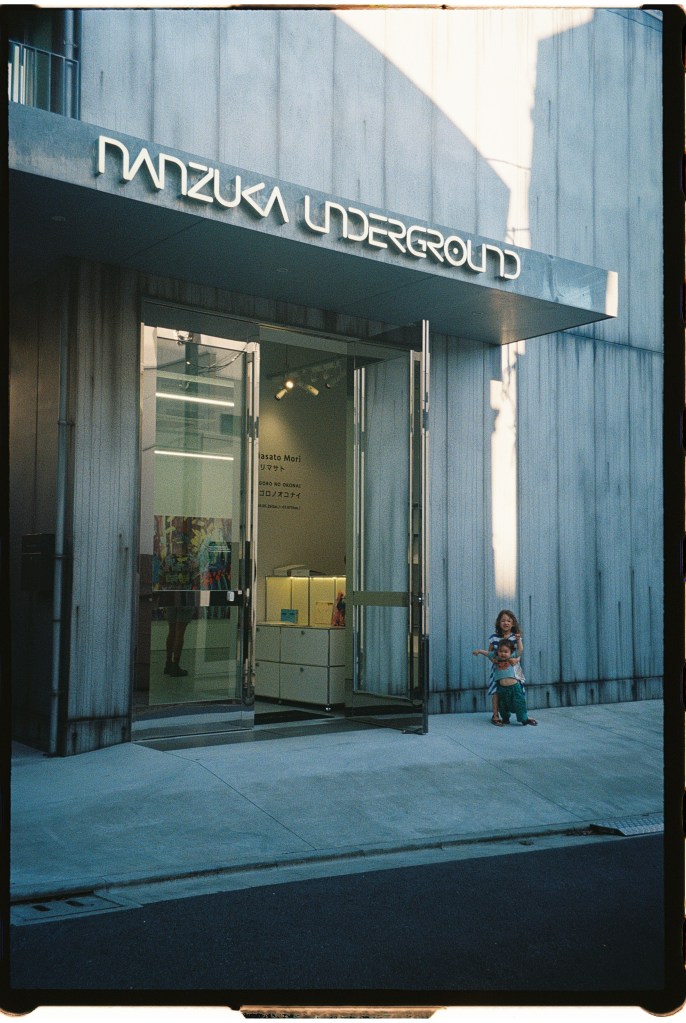
Nanzuka Gallery, Common Gallery, Target Gallery and Espace Louis Vuitton
Julien comes home around 16:30 and suggests we go check some galleries in Harajuku. Most galleries open until 20:00, some even later. Harajuku is the Mecca for modern art galleries, all in within walking distance from each other. Afterwards, we plan to visti a sento – a local bathhouse – and go out for an easy dinner.
We leave around 17:00 and visit Nanzuka Gallery, Common Gallery, Target Gallery and Espace Louis Vuitton. Nanzuka Gallery shows large, colourful canvasses of Mustone Obake, which the kids really like. Common Gallery features raw, industrial textile sculptures of Chicago artist Jacqueline Surdell. At Espace Louis Vuitton, there is a sound system installation of British artist Mark Leckey, along with a massive inflatable Felix the Cat. It’s quite impressive and playful.
I love going to galleries with the kids, because they are generally small and good for their short attention span. They always have opinions or are drawn to specific works and colours.
This area is very lovely. The streets are busy, but nothing stressful. People in Japan, specifically in Harajuku look so stylish. They’re fashionable, but never tacky. (unless you go to Shibuya or Roppongi on a Friday night)
The sun is low and not as torrid as earlier. The kids are in a good mood, after their long rest. Besides, we know we will end our tour at the sento, and we are all looking forward to soaking in the water.

A No-Tattoos Kind Of Sento
I used to go to the sento at Omotesando a lot when I was living in Harajuku in 2010. Especially in summer. Back then, I’d take a bath before or after dinner. Sometimes before going out for drinks or to the club. The sento stays open until midnight, so you can go pretty much anytime.
Sadly, it doesn’t allow people with tattoos and Julien has to go back home. I feel really bad for him, but L. is so excited to go, that I have to go with her. (The guide gives addresses of lots of sento that don’t have any problem with tattoos!) The sento is full of old ladies. They all seem to know each other and chat away. There are 4 different baths, of which one is milky white. It’s the bath that is the least hot, so we spend most time there. There is also a cold bath which I love. It makes our whole body tingle after the heat of the warm bath.
When we leave the sento the sun is nearly set, and Omotesando looks beautiful in the twilight. We feel high from the bath, very light and refreshed. L. spots some tourists, a couple of elderly people, sitting on suitcases with build-in motors. They drive behind each other, over Omotesando Dori, street. It looks ridiculous and funny, but also very convenient.
Frozen Margaritas in Harajuku
Julien and I. are waiting for us, at a nearby Mexican restaurant. I’m a bit surprised by the choice, but it seems like a nice place and as usual the food is really great. After 20:00, when the shops close, Harajuku gets so calm and quiet. The restaurant is on the ground floor. It is small, with wide open doors and the kids play outside while we drink Frozen Margaritas. Life is good, and I feel so blessed with this adventure.
I order a vegan burrito, with lots of vegetables and avocado and spicy sauce. L. eats quesadilla and fries and loves it. It is good to see her eat. Not the healthiest dinner, but at least she eats. I. eats half of my burrito and fries. The jetlag finally seems gone. We have one more Margarita, before we go back home.
Leave a Reply