
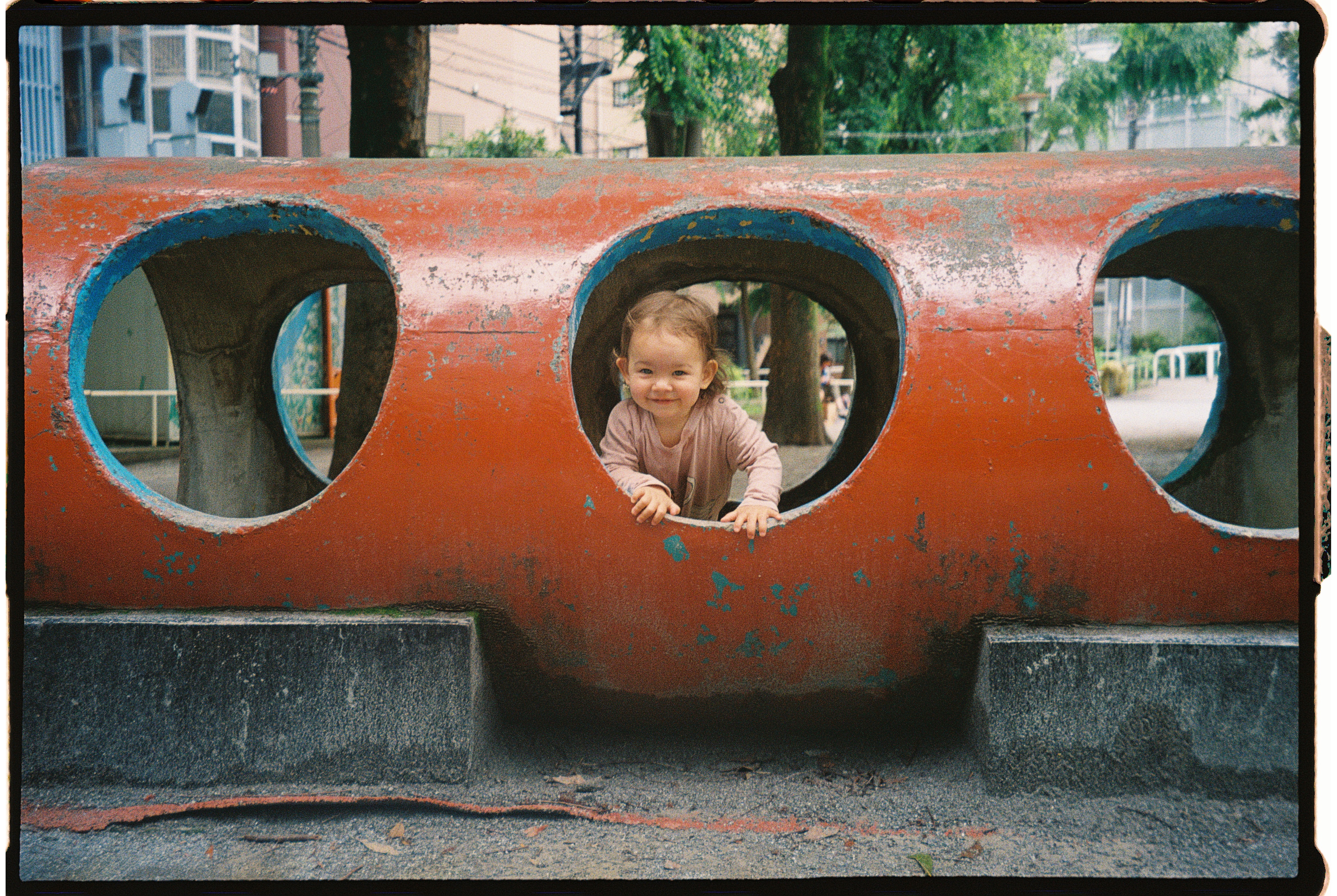
June 10th, the first day in Tokyo
A lot has been said and written about jet-lag. Most of the time we read that we should adjust to the clock of the country straight away, but even after travelling here for a decade I don’t know how to do it. Especially with young children. I can hardly take I. through Tokyo on 4 hours of sleep. It would be torture for her. Taking L. out on little sleep would be torture for her and for everyone around her. She gets loud and almost aggressive on little sleep.
So generally we just go with the flow. In a way, Tokyo is a good place for the kind of jet-lag we have. Everything starts late here. The shops open at 11:00 in the commercial centers. And everything continues until deep in the night. If we truly can’t sleep, we can always go to karaoke or play bowling. We can go out to eat an ice cream somewhere, or take a long bath at home.
I. and I wake up just before noon, while L. and Julien are sleeping again. I notice Julien has bought food at the convenience store. He must have gone after he woke up with L., around 5:00. Convenience stores are shops are open 24/7.
There is warm steamy rice in the rice cooker (of course, any house in Tokyo has a rice cooker ) and natto (fermented soy beans), some pickles and tofu.
Our children love eating natto. Natto looks unpleasant – like a beige smelly and sticky bunch of beans – but coming from the continent of cheese, I’m sure you’ll find it tasty! I noticed that people who do not like cheese, usually also don’t like natto. Natto is a super healthy, power food, much better than cheese!
I make I. breakfast and wake them up. Julien booked a haircut in Ebisu (the best haircuts are in Japan of course, mentioning a bunch in the upcoming guide!) and we have to hurry to be there on time.

Discovering Ebisu Park
We are very close to Harajuku Station and Ebisu Station is only 2 stops away on the JR Yamanote line, a line that circles around Tokyo. It comes every 2-3 minutes, so you never have to wait.
Once we waved Julien goodbye in Ebisu, the girls and I go get me a coffee before we head to a playground. We brought a stroller, a YoYo, and the board for behind the stroller on which L. can sit. Last year I brought the board too, but we didn’t use it at all. L. was 3.5 years old and she was very envious of her at that time 5 months old sister. I. was a bit too young for the upright positioned YoYo anyway, so in the end I carried I. in the carrier and pushed L. in the YoYo for like a month. This time, it’s different. L. is comfortable on her new throne and I. is too heavy to be carried around all day anyway. I’m quite content with this convenient solution.
I find a coffee shop nearby Daikanyama station. The girls want babyccinos. I’m aware ordering two babyccinos is quite a luxury but I’m also happy if they drink some oat milk; especially L. who isn’t a good eater. And its hard to refuse I., because I. wants to eat and drink everything we eat and drink. They are quite opposites of each other.
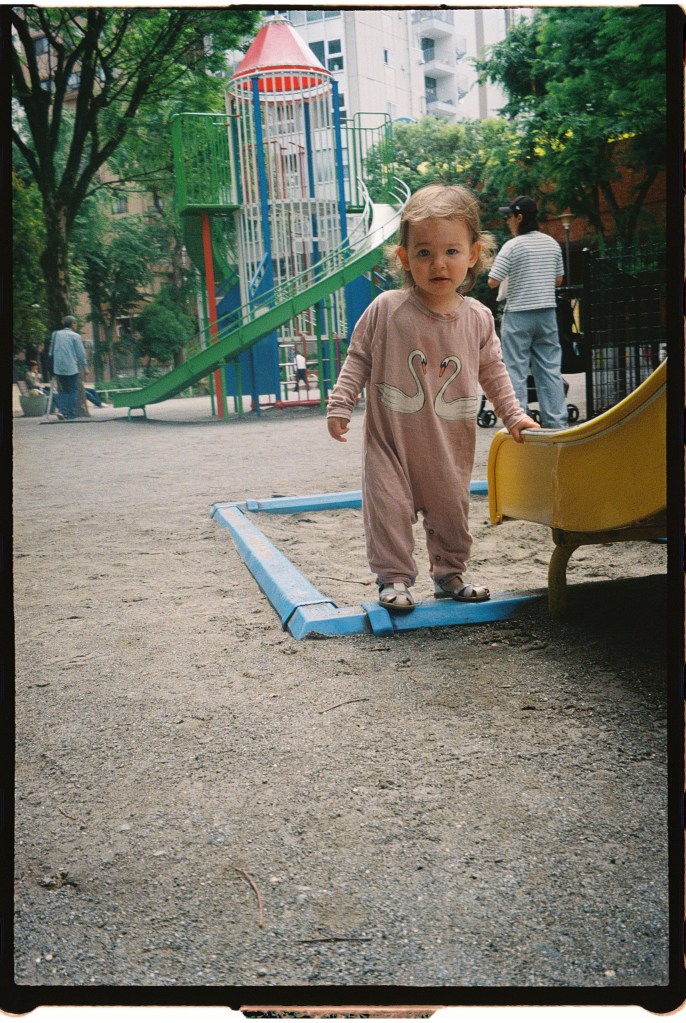
I take the girls to Ebisu park, where you have a lovely playground. The equipment looks old but is well maintained. Everything is steel and painted in bright primary colours. There is a cement train, with faded paint that looks like a prop from a 90s film.
The park is full of tall, old trees, something I love in Japan. Most playgrounds offer shade, or at least to some extent. In the Netherlands you are burnt alive in the sand pit on a cement square.
Just as I have taken I. out of the stroller and installed me and my coffee, L. runs to me screaming that she needs a toilet NOW. Of course… I pick up I. – who was just on her way to the slide and who screams and cries angrily – put her back in the stroller and make my way out to find a nearby convenience store. But just as we near the exit of the park I discover a public toilet. It’s a big nicely designed space. Its clean. There is even toilet paper.
The hygiene in Japan has truly restored my faith in education. People: it is possible. Even the biggest slob can learn to clean up his or her mess in public spaces. Tokyo is always clean. The streets are clean, the toilets are, the public transport. And there are no bins anywhere in sight.
My friend Tetsuya told me that since 9/11 Tokyo removed its public bins and never replaced them. They probably realised that even without them, the streets were still proper.
According to Julien its clean in Japan because kids learn to clean up from a very early age. In elementary school, they clean up their own class room every day before going home. Like really clean. They clean the floor, the tables, the chairs, the toilets.
It might also help that no-one wears shoes inside, also not in schools. It creates a certain awareness. My child doesn’t even clean her hands before she eats her lunch in school. Something like that would be unimaginably here I suppose.
“Tokyo is always clean. The streets are clean, the toilets are, the public transport. And there are no bins anywhere in sight.”
One more story on hygiene before I move on, but it came to mind when I noticed those clean toilets. When I was studying in Tokyo, I went to a summer festival in the mountains. It was called Taico Club, and it was 24 hours – from noon till noon – of dancing and partying. We had a tent, but for all obvious reasons we didn’t sleep. We just danced until noon the next day and we went home while doing a short break at a nearby onsen on the way. Someone must have driven us back to Tokyo. I don’t remember who but I’m happy to be alive. Anyway: it was my first festival and I was amazed by the fact that there was NOTHING on the floor. Mind you, in Japan everything is plastic. Still. In 2010, but also nowadays. There was not a single plastic cup or a beer can on the dance floor. When we cleaned up our tent on the camping site and walked back to the parking lot, I didn’t find anything, not a cigarette butt on the ground. There was still grass. It didn’t get soggy and dirty in the forest from all the spilled drinks. It was almost as if nothing happened. And it felt so good to leave it behind like that.
I’m not saying Japan is superior – I also noticed a scared to death chihuahua in a handbag on the techno dance floor and in the very early morning there was a 2-year old scared to death kid crying in his wasted dads dancing arms, I still see this kid in nightmares – but when it comes to hygiene, Japan is clearly the master.
Soba in Ebisu
Julien looks good with his new haircut. It’s a bit different than before. A bit less Peaky Blinder, more normal. But nevertheless, he looks good. As usual.
We go have a late lunch – soba again – at a random soba restaurant. Meanwhile its past 2pm and we decide to just go to a soba place with a decent rating on Google. A lot of places close around 14:30 so we can’t be picky anyway.
I love the place we find, because the kitchen is open and we can see someone cook. Julien thinks it looks dirty. It does look old, but I don’t think it’s dirty but charming. There is a lot of wood. The door in the back is open and the sound of people talking mixes with the television in the kitchen and the music of the soba restaurant. It seems a lot, but somehow it works. We eat soba and tempura which tastes great as usual. The kids are very tired and they both hardly eat.
I have this amazing baby/toddler seat helper which I always bring in the diaper bag. It has proven to be quite useful many times if there are no baby chairs available. I. is sitting in this harness, on a normal chair, but I see her eyes closing and her head is nodding. It looks a bit funny: she needs a nap.
When we go out I put L. in the YoYo and I. in the carrier. They both sleep within a minute. I don’t want to use the carrier too often this year because I easily go past my limits with regard to my body. These jet-lag days are an exception. (And I secretly miss I.’s little body close to me in the carrier.)
We walk around Daikanyama, and do some window shopping. Daikanyama is quite posh and has a lot of high-end brands. We end up at Daikanyama T-Side where we briefly read some of the art and design books on the ground floor before the children wake up and we walk back to Ebisu Station.
Japanese Crêpes!
Julien has a meeting followed by an event and he has to be there from 4pm until at least 10pm. I take the train back towards our apartment in Harajuku with the children.
L. is hungry. She didn’t eat much at lunch. We walk over Takeshita Dori, surprisingly calm for the moment of the day. Somewhere in the middle, on a corner, you find a legendary Japanese ‘crêpe’ shop called, Marion Crêpes.
Crêpes? Yes. Crêpes. And your kids probably loves them just as much as mine. They are not made with buckwheat – as you could have expected in Japan – but with wheat flower and they are filled with cream, custard, fruits and even ice cream if you like. Marion Crepes offers a nice crispy one, not always the case. It’s always busy, but sometimes you can get lucky, like we are today. I decide to buy them one to share.

Feeling Humble at Meiji Shrine
After this sugary break, I take them to Meiji Jingu Shrine which is situated in a beautiful old park next to Yoyogi Park. At the entrance of the park is a tall torii, an traditional Japanese gate that is usually at the entrance of a shrine. (A torii is also a good way to distinguish the difference between a Buddhist shrine and a Shinto shrine!) The torii symbolises the transition from the common world to the spiritual one. The kami deities can enter using this torii. We too can enter using the torii, but we cannot walk or enter through the middle of the torii. The middle is where the kami go. It would be disrespectful.
Instead, we walk on the far left side of the gate and we bend before we enter, to show our humbleness. I feel humble. The entrance is so tall and the trees are so tall and old. It frankly feels as if you are entering a divine place. Full of forest spirits and creatures that have been there for centuries. In the middle of Tokyo. Everything seems old and holy. Even the great stream of people, of which a lot are tourist, can’t change that.
“After entering the park, we follow two salary men – two people in suit with small suitcases – and we secretly copy their behaviour.”
After entering the park, we follow two salary men – two people in suit with small suitcases – and we secretly copy their behaviour. This shrine is very important and there are 2 more torii to pass. We follow the men and bow several time before passing the second torii. Most people walk around it, left or right, but I want to give L. the experience and I try to explain it to her as best as I can.
Just before the last torii, before we enter the holiest ground, we have to purify our body by cleaning our hands and mouth with running water. There is a water source, with wooden spoon-like objects. You scoop some water, and pour it over your left followed by your right hand. After, you scoop some water and pour it in your left hand to clean your mouth. The girls love this ritual of course. It’s warm. It takes time to get them move forward, so I lose the salary man. That’s ok; we can manage from here.
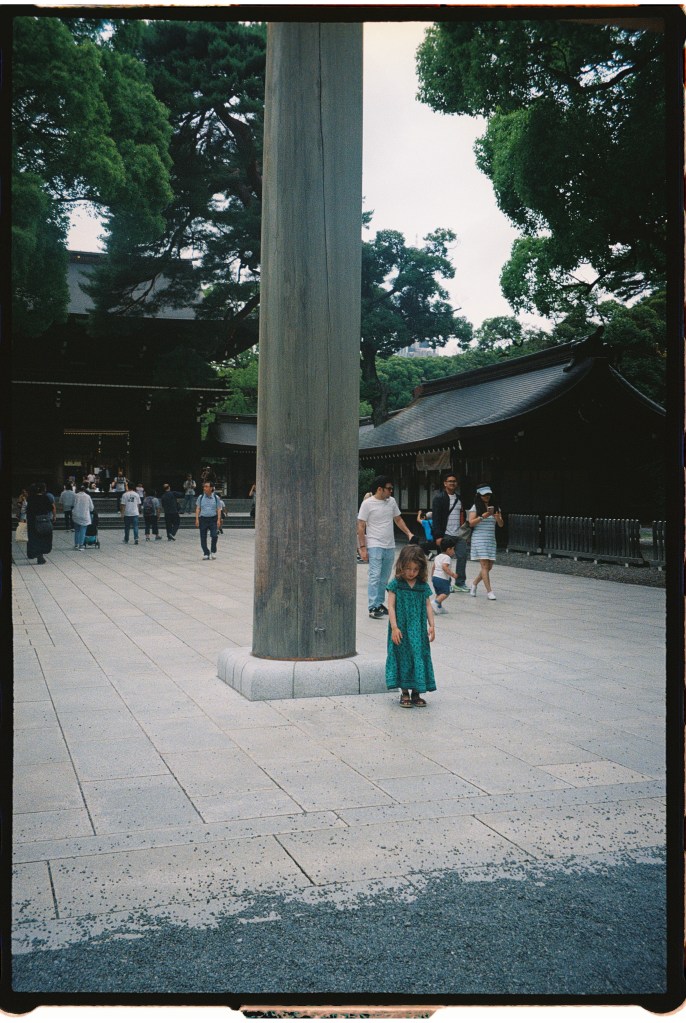
We enter the 3rd gate, bowing deeply. I. is part of the team too now. She was in the stroller before but she watched us well and she bows so deep that her head touches the floor.
We go to the holiest part of the shrine where I give both girls a 5-yen coin. The 5-yen (go-en) coin is a special coin. A circle, also ‘en’, is considered a very positive symbol in Japan depicting integrity, infinity and eternity. Besides, the sound ‘en’ also means connection or fate. The fact that Julien and I met again in Paris ten years after we met in Tokyo and now have a family is ‘en’. The word go-en can mean 5 Yen but it also means fortunate relations and connections. Therefore it is the best coin to offer at a shrine or a coin you can give to someone.
First of all, we ring the bell, to say hello to the kamisama, the deities. Then we throw our coins. We bow twice, clap once and bow one more time. Normally you take a moment to think of something, but I can’t really, because I. is always trying to run down the stairs.
When we walk back we softly sing Japanese children’s songs.
Furikake, Natto and Umeshu
I pass by the house to drop off some bags and get a big shopping bag. I go to a supermarket – another 20 minute walk. It’s 18:00 by now, but we are jet lagged and have nothing to do anyway. I do some easy shopping and buy some of the already prepared meals in the supermarket. Carrot and bamboo salad, Inari sushi, furikake, natto – of course – , tofu, and some veggies. I also buy yogurt and some sweet and salty snacks for if Julien and I want to watch something on that big screen in the apartment later.
Back at home I let L. watch something while I. empties every possible shelf, and I prepare a simple dinner for us. I’m so grateful to be in an apartment and not in a hotel. It has been an overwhelming day for all of us.
A lot of parents with kids ask me how to continue your old life with a kid by your side. I think the answer is you can’t. Yes, you can get a baby sitter and daycare, but even with some help, life is just different. And it’s ok. Normally we would have forced ourselves to go out for dinner, had quite a few drinks, but today, I’m in an apartment preparing a simple dinner from a local supermarket. I can drink a little umeshu, plum wine, reflect on the day and think about what to do tomorrow when the kids are sleeping. I really don’t mind.
I. and L. sleep around midnight, and I too go to bed. I wake up two hours later, and I can’t sleep anymore. I start thinking about this guide and about all the ideas I have and all the places I want to visit before the end of the week. So after an hour of fighting against my thoughts, I decide to get out of bed and just write them done. With the terrible stress that the kids will wake up at 6am, when I just lay my head on the pillow.

Leave a Reply